
Keeping watch on water quality in Merri Creek
01st November 2026
By Polly Bastow, FoMC committee member
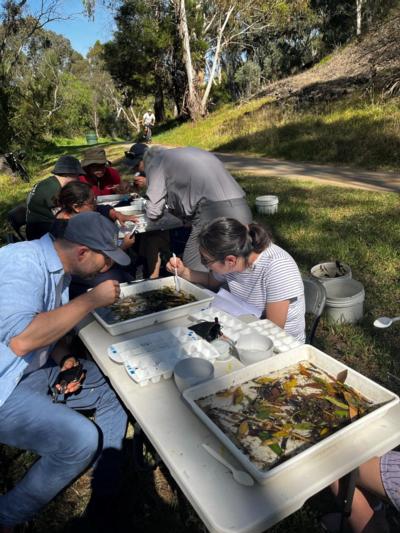
WaterWatch training with Trevor Hausler funded by Melbourne Water 2025. Image: MCMC
A healthy platypus eats a third of its body weight in waterbugs a day. This could be key to why we haven’t seen platypus in Merri Creek for some time.
We know there is insufficient food in the water for platypuses, because WaterWatch (citizen science water quality monitoring teams), has been recording data on waterbug diversity and population along Merri Creek for some years.
I spoke to Julia Cirillo, MCMC’s Coordinator of Citizen Science and Waterway Education (amongst other MCMC projects), about her work supporting the 11 WaterWatch (WW) groups within the MCMC region.
Nine sites are monitored monthly by seven WW groups along Merri Creek and tributaries, including the Curly Sedge and Edgars Creeks. These WW volunteer groups consist of a wide variety of community-minded people, from scientists, school and university students, teachers, artists and retirees; all keen to know what’s in the creek and whether the water quality is improving.
The groups meet once a month to sample the water, check salinity, turbidity, nutrient and oxygen levels, temperature, and, for some groups, complete biological surveys of the insects and frogs alive in the water. Julia has worked with the groups to standardise their information and reporting methodology and provide advice when issues arise. Groups, such as the Friends of Merri Creek Stream Team in Fitzroy North, have been doing this work since 2003 and have amassed a great archive of Merri Creek data.

WaterWatch training with Trevor Hausler funded by Melbourne Water 2025, photo, MCMC
The WaterWatch water quality and waterbug reports include a fascinating group of photos identifying creatures scooped out of the creek at a series of established testing sites. Typically, reports will show aquatic worms, leeches, mussels, glass shrimps and water pennies. To the uninitiated, this seems a reasonable variety, but they are representatives of a group sadly defined as being “pollution tolerant.”
We could have a much richer variety and number of creek dwellers (more attractive to platypuses, for example) if the water quality wasn’t so poor. Storm water run-off, flowing from surrounding roads, roofs, gardens and industry is presumed to be the main driver of low water quality. Rain water collects noxious pollutants such as ammonium and phosphates, oil grease and heavy metals, delivers them to our waterways through stormwater drains at such a concentrated speed, that it disturbs sediment and sweeps away habitat pools.
Recently, volunteers monitoring at Moomba Park Wetlands by the Merri in Fawkner, not only reported on water quality, but helped collate information on the local Growling grass frog population for Melbourne Water’s frog census.
The group also detected a pest in the area, Julia explained: “There's been an outbreak of Gambusia, common name mosquito fish, that have been found in Moomba Park Wetlands. The volunteers reported that to Merri-Bek Council and, with MCMC staff, have provided some recommendations for removing them.”
Ideally, the next step is to have greater analysis of the WaterWatch data collected on Merri Creek. Work is needed to explore the connection between revegetation and water quality, to describe the impact of turbidity on the biology of the creek and to document and predict the effect of climate change on our urban waterways. These investigations could lead to practical strategies for good water and land management and may suggest new approaches to long-term problems.
‘WaterWatch data is available to the public via our online data portal. It's useful for people in the education field, land managers, stakeholders, and anyone passionate and interested in trying and pushing for change ….to see the rivers, or creeks, improve,” Julia says.
Although the creek quality rarely rates above the waterbug SiGNAL (Stream Invertebrate Grade Number Average Level) score of 4 (indicating moderate to severe pollution), there are the occasional heartening discoveries. Julia described her recent surprise at a Merri Creek testing site, just north of Coburg Lake, where the FoMC Coburg Lake Working Group is undertaking extensive revegetation. ‘We found a very tiny stonefly – a local water bug. These waterbugs are quite sensitive to pollution. I haven't seen a stonefly in Merri Creek for years.”
If you are interested in joining the FoMC WaterWatch team, the group meets on the first Sunday of the month — the details of the testing site, dates and time can be seen on the FoMC calendar.
- Community Citizen Science water monitoring - find other Merri Creek WaterWatch groups
- Find my waterway - find groups around Victoria
- WaterWatch water quality summaries - find all finalised reports